
Too Long; Didn't Read
- If your fingernail catches in the scratch, it is too deep to polish out reliably — replacement is the honest answer.
- Surface scratches (fingernail slides over them) can often be removed with cerium oxide and a felt polishing pad.
- Polishing always carries a distortion risk. An uneven polish on flat glass creates a subtle lens effect that is visible in direct light.
- Tempered glass has a hardened outer skin. Aggressive polishing breaks through that skin and can cause the pane to shatter — know what type of glass you have before you start.
- Scratches on IGUs (insulated glass units — the double-pane sealed units in most Toronto windows) cannot be polished from the inside. A scratched inner surface means glass-only replacement.
Can You Repair Scratched Glass?
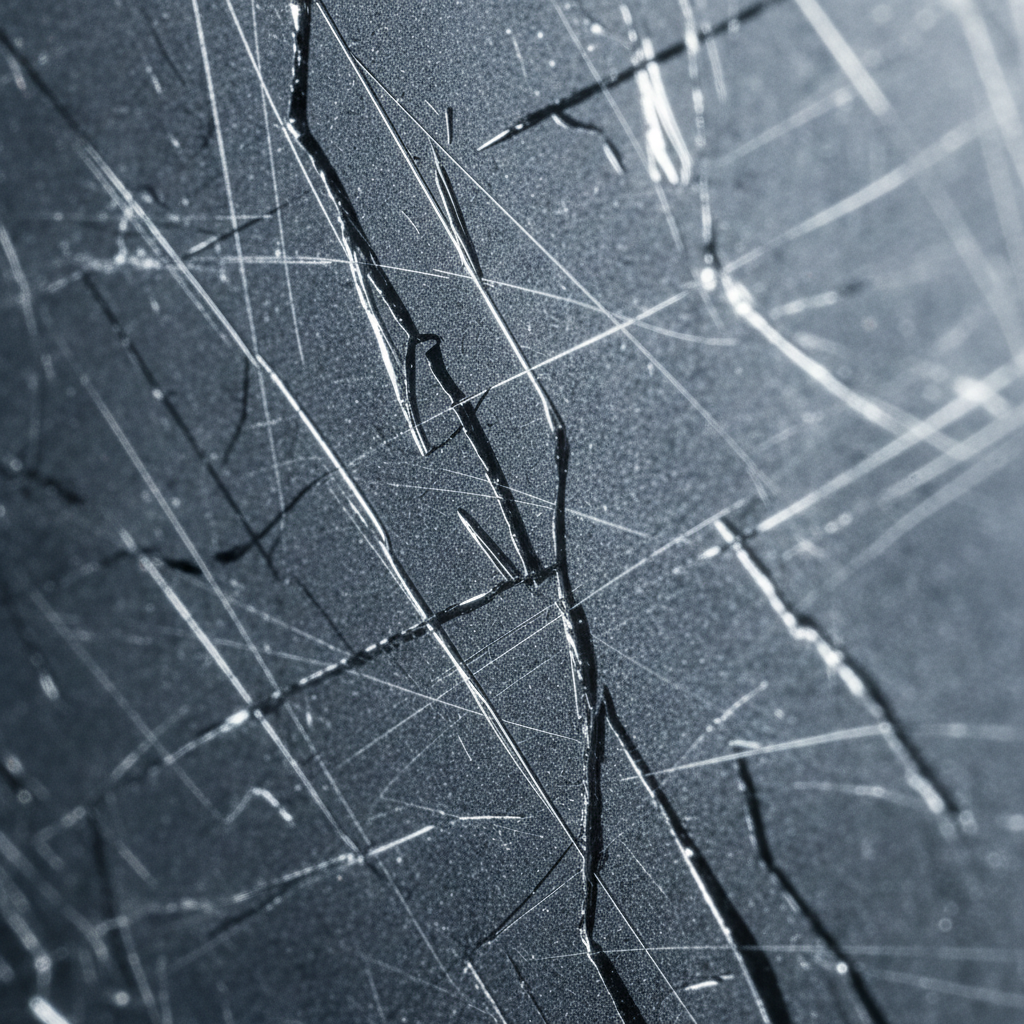
Answer first: Sometimes — but the honest answer depends on one simple test. Run your fingernail across the scratch. If your nail glides over it without catching, the scratch lives in the surface coating or the top few microns of glass and can likely be polished out with cerium oxide. If your nail catches, the scratch is deep enough that polishing becomes a trade-off: you might remove the scratch, or you might end up with a distorted pane that is harder to look through than the scratched one was. At that depth, glass-only replacement is usually the cleaner option.
The scratch appeared out of nowhere. Maybe a contractor scraped a window with a ladder bracket. Maybe someone cleaned the glass with a green scrubby pad. Maybe a kid ran a stone along the patio door. Now there is a line across the glass and you are wondering whether to call for a repair or just live with it.
I have assessed a lot of scratched glass across the GTA over the years — windows in North York post-war semis, shower enclosures in Leslieville condos, commercial storefronts in Etobicoke. The situation is almost never as simple as the internet makes it sound. Polishing works on a narrow range of scratches. Applied to the wrong pane, it causes damage you cannot undo.
This guide covers the full picture: how to assess your scratch honestly, what polishing actually does to glass (and what can go wrong), which scratches are worth trying to repair, and when the correct call is a clean replacement.
The Fingernail Test: Why It Works
Before you buy anything or call anyone, do this. Press your fingernail firmly against the glass at a 45-degree angle and drag it across the scratch slowly.
Nail slides over without catching. The scratch is shallow — likely under 100 microns deep, possibly just in a surface coating or the top layer of the glass itself. Cerium oxide polishing has a reasonable shot at this. You should see meaningful improvement, and a skilled professional will get it close to invisible.
Nail catches or drops into the scratch. You can feel a definite edge. The scratch has cut through the surface layer into the bulk glass. At this depth, polishing requires removing significant material to level the surrounding glass down to the bottom of the groove. That means time, heat, and uneven abrasion — all of which introduce distortion risk. Replacement starts to make more financial and practical sense.
Nail drops into a gouge. Not a scratch anymore. This is impact damage or a deep abrasion. Polishing is not a viable option. Replace the pane.
Quotable nugget: A scratch your fingernail catches in is at least 0.1mm deep. To polish that out, you need to remove enough material from the surrounding glass to bring the surface down to the scratch floor — and every millimetre of uneven polishing adds measurable optical distortion.
The test is not perfect. Scratch width and location matter too. A deep scratch in the corner of a window pane is a different conversation than the same scratch centred in your line of sight. But the fingernail test gives you an honest first read without spending a dollar.
What Cerium Oxide Actually Does
Cerium oxide (CeO₂) is a rare earth compound that has been used for glass polishing since the mid-20th century. Understanding how it works explains both why it is effective on shallow scratches and why it is risky on deep ones.
Cerium oxide — a fine white powder mixed with water into a slurry — works through a combination of chemical reaction and mechanical abrasion. The chemistry is what separates it from sandpaper: at the right temperature and moisture level, cerium oxide reacts weakly with the silica in glass, softening the surface layer slightly while the abrasion smooths it flat. This dual action means it removes material more gradually and evenly than a purely mechanical abrasive.
For surface scratches, this is exactly what you want. The cerium oxide slurry levels the micro-ridges at the scratch edges, smoothing them into the surrounding surface until the optical discontinuity disappears.
For deep scratches, the same process becomes the problem. To reach the bottom of a deep groove, you have to bring the surrounding glass surface down to meet it. That means more passes, more heat, more material removal — and each pass concentrates wear wherever the polishing pad sits longest. The result is a shallow depression in the glass, not a flat surface. In direct light, that depression bends incoming light the way a lens does.
[Image Idea: Side-profile diagram showing a shallow scratch being levelled vs. a deep scratch creating a lens-shaped depression after aggressive polishing]
Professional technique matters enormously here. Cerium oxide applied at 500–600 RPM with controlled pressure and consistent movement removes approximately 0.0001 inches of material per pass. A professional doing this by hand or with a variable-speed polisher can monitor distortion as they go and stop before it becomes visible. A homeowner with a drill-mounted felt pad running at full speed, working the same spot repeatedly, will often create more visible distortion than the original scratch.
Quotable nugget: Polishing glass for too long in one spot creates a "lens effect" — a subtle curvature that bends light and causes wavy distortion visible when you look through the pane at any angle.
The Tempered Glass Problem
This is the part that most DIY guides skip over, and it matters for most Toronto homeowners.
Tempered glass — also called toughened glass — is standard in shower doors, sliding patio doors, glass railing panels, sidelights beside entry doors, and any glass within 1,500mm of a floor in Ontario (as required under the Ontario Building Code). In high-rise condo balcony glazing, it is nearly universal.
Tempered glass is made by heating annealed glass to around 620°C and then rapidly cooling the surfaces. This creates a compressed outer skin — roughly the outer 20–25% of the glass thickness — with the interior under tension. That compression is what makes tempered glass roughly four times stronger than regular glass and causes it to shatter into small, relatively harmless pebbles rather than dangerous shards.
The problem: that compressed outer layer is exactly what you are polishing away when you try to remove a scratch.
Break through that layer unevenly and you alter the stress distribution in the pane. In a worst-case scenario, the glass shatters spontaneously during polishing. More commonly, you end up with a pane that has compromised structural integrity in the polished area — it may pass a visual inspection but will be significantly weaker than spec.
How to check if your glass is tempered: Look for an etched or printed label in the corner of the pane — it should say "Tempered," "Safety Glass," or reference CSA B247 (the Canadian standard for safety glazing). If the label is missing, you can also look at the glass edge (if accessible): tempered glass has a smooth, rounded edge; annealed glass has a sharper, rougher cut edge.
On tempered glass, our position is simple: light surface haze only, low-speed polishing, and stop at the first sign of distortion. Anything that catches your fingernail on tempered glass — replace the pane.
When Repair Makes Sense
Not every scratch is a replacement. Here is an honest triage framework:
Scratches Worth Attempting to Polish
- Fingernail slides over without catching
- Located on annealed (non-tempered) glass — interior decorative glass, older single-pane windows in Toronto heritage homes, some glass tabletops
- Single isolated scratch, not a pattern of abrasion across the full surface
- Not on a low-E or other coated surface (more on this below)
- Not on the inner surface of an IGU
Scratches That Should Go Straight to Replacement
- Fingernail catches or drops in — the depth is too significant for reliable, distortion-free polishing
- Any scratch on tempered glass deeper than surface haze
- Scratches on the inner surface of a sealed double-pane unit (the pane facing the argon gap) — you cannot reach these without breaking the seal, at which point you are replacing the IGU regardless
- Scratches across low-E coated glass — the metallic coating is typically less than 100 nanometres thick, and polishing will remove it unevenly, destroying its energy performance properties
- Multiple deep scratches across a large pane — total repair cost exceeds 50% of replacement cost and you still end up with a polished pane, not new glass
For Toronto homes with sealed IGUs — which is most residential double-pane construction built after the mid-1990s — a scratched outer surface pane is actually a good candidate for glass-only replacement, which replaces just the glass unit inside the existing frame rather than the full window. That saves 40–60% compared to a full window replacement and you get a new, pristine pane rather than a polished-and-hopefully-not-distorted one.
The Distortion Problem: What to Look For
If you are assessing a polished repair — whether you did it yourself or hired someone — here is how to check for distortion before you accept the work.
Stand back from the glass, three to four metres away, and look through it at a straight horizontal line. A window frame opposite, a door frame, the edge of a countertop. Move your head slowly side to side while keeping that line in view.
On good glass with no distortion, the line stays straight across the full pane. On glass with a polished depression, you will see the line bend or waver as it passes through the polished area — even if the scratch itself is gone.
This is the distortion trade-off that nobody in the "DIY glass scratch removal" space talks honestly about. A scratch is a line. A lens effect from aggressive polishing is a zone. If the zone covers your central sight line through the window, the distorted glass is more visually disruptive than the original scratch.
The distortion check is why any professional glass scratch repair should include a viewing assessment at completion, not just a close-up look at the scratch itself. If you are hiring someone, ask for this explicitly.
Quotable nugget: A repaired scratch that introduces visible optical distortion has not actually been fixed. The glass has been altered, and the alteration is permanent.
DIY vs. Professional: An Honest Comparison
| DIY Cerium Oxide | Professional Polish | Glass-Only Replacement | |
|---|---|---|---|
| Scratch depth | Surface only (nail slides over) | Surface to moderate | Any depth |
| Tempered glass | Not recommended | Extreme caution only | Yes |
| Distortion risk | High without technique | Low with skill | None — new glass |
| Cost | $30–$80 (materials) | $150–$350 | $200–$600 (Toronto, 2026) |
| Result guarantee | None | Depends on contractor | New glass clarity |
| Time | 1–3 hours | 1–2 hours | Same-day or next-day |
The DIY case is strongest for: single, shallow, non-tempered scratches on glass where distortion in that area would not bother you much — a small scratch near the frame edge of an interior decorative pane, for instance.
The professional polish case is strongest for: moderately shallow scratches on valuable or hard-to-source annealed glass, where a skilled technician with proper equipment can deliver a genuinely good result.
Glass-only replacement wins on: anything deeper, anything tempered, anything on an IGU inner surface, or any situation where the economics are close. You end up with factory-new glass.
A Note on Coated Glass
Low-E coatings, anti-reflective coatings, and self-cleaning coatings (like Pilkington Activ) are invisible metallic or oxide layers applied to the glass surface during or after manufacture. In Toronto homes with ENERGY STAR-rated windows, the inner pane almost always has a low-E coating — usually Cardinal LoĒ-366 or an equivalent product.
Polishing a coated surface removes the coating in the polished area. Depending on the coating type and where it sits (surface 2 or 3 of the IGU), removing it:
- Reduces thermal performance — low-E coatings in Ontario windows are responsible for 20–40% of the window's overall insulating efficiency
- Creates a visible visual anomaly — a polished spot on a low-E pane often appears slightly different in colour or reflectivity than the surrounding surface
- Voids any remaining manufacturer warranty on the glass unit
How to identify a coated surface: Hold a lit match or lighter in front of the glass at an angle. You will see multiple reflections of the flame (one per glass surface). A coated surface produces a reflection that is a different colour than the uncoated reflections — typically blue-green for low-E. If the scratch is on a surface that shows a coloured reflection, assume it is coated and do not polish it.
What About Graffiti Scratches?
This deserves a separate mention because it comes up on Toronto commercial properties and street-level condos.
Graffiti scratching — where someone uses a key, coin, or diamond-tipped tool to carve text or patterns into glass — is almost always deep enough to catch a fingernail. The scratches are intentional and applied with force. They are also usually across a large surface area.
For scratched storefront glass or commercial glazing, professional restoration services do exist and use progressively finer abrasives starting at 60–120 micron grit diamond pads before finishing with cerium oxide. This works, but it is time-intensive and the distortion risk on large commercial panes is significant.
On anti-graffiti film — a sacrificial layer applied over storefront glass in high-risk areas — the film absorbs the scratch and gets peeled off and replaced for a fraction of the cost. If your storefront is not already protected, this is worth considering alongside any repair. For Toronto storefronts dealing with repeat incidents, we have written separately about anti-graffiti film application and the tradeoffs versus glass replacement.
The Repair vs. Replace Decision Tree
One more framework to make this concrete:
Step 1: Fingernail test. Nail catches? Go directly to replacement assessment. Nail slides? Continue.
Step 2: Is it tempered glass? Check for the etched safety mark. Yes → professional polish with caution or replace. No → polishing is more viable.
Step 3: Is it a coated surface (low-E, anti-reflective)? Flame test. Yes → replace. No → continue.
Step 4: Is the scratch on the inner surface of an IGU? Yes → glass-only unit replacement, full stop. No → continue.
Step 5: Get a repair quote alongside a glass-only replacement quote. If repair is less than 50% of replacement cost and the contractor can show you completed jobs without distortion, repair is worth trying. If quotes are within $100 of each other, take the new glass.
Frequently Asked Questions
Does toothpaste actually remove scratches from glass?
Only on very fine surface haze — scratches barely visible to the naked eye. Toothpaste is a mild abrasive, but it lacks the chemical reactivity of cerium oxide and removes almost no material. Do not expect visible results on any scratch you can clearly see.
Can scratched tempered glass be polished?
With extreme caution. Tempered glass has a compressed outer layer roughly 20–25% of the total thickness. Polishing through that layer removes the compression that makes the glass safe. For anything beyond the lightest surface haze, replacing tempered glass is safer than aggressive polishing.
How much does professional glass scratch repair cost in Toronto?
Professional scratch removal in the Toronto area typically runs $150 to $350 per pane for surface-level work, depending on pane size and scratch severity. For comparison, a standard residential glass-only replacement runs $200 to $600 in 2026. If quotes are close, replacement gives you new glass with no distortion risk.
What causes scratches on window glass in Toronto homes?
The most common culprits are window cleaning with abrasive materials (steel wool, rough scrub pads), construction debris and wind-driven grit during nearby renos, and kids or pets dragging hard objects across a pane. In older Etobicoke and North York homes, leaded or sand-blasted decorative glass scratches more easily than modern float glass.
Can I polish scratches out of a shower door myself?
Possibly, if the scratch is shallow and the door is annealed (not tempered) glass. Most shower doors in Toronto homes built after 2006 are required to be tempered under the Ontario Building Code, so confirm the glass type first. On tempered shower glass, DIY polishing with a drill-mounted felt pad risks both distortion and structural failure.
Not sure whether your scratched glass is worth repairing? We assess scratches honestly — we will tell you if a polish is a good bet or if a glass-only replacement makes more sense for your situation. Take a look at our residential glass repair and replacement services or reach out to describe what you are dealing with. No obligation to book anything.