
Too Long; Didn't Read
PDLC smart glass switches from transparent to frosted when voltage is applied, running on a 48V AC transformer wired to a standard household circuit. For Toronto home offices, expect to pay $85-$150/sq ft for factory-laminated smart glass or $30-$45/sq ft for retrofit smart film applied to existing panes. Both options integrate with smart home platforms like Google Home and Apple HomeKit. A licensed electrician handles the transformer-to-mains connection, while your glass installer manages the panel leads and low-voltage wiring.
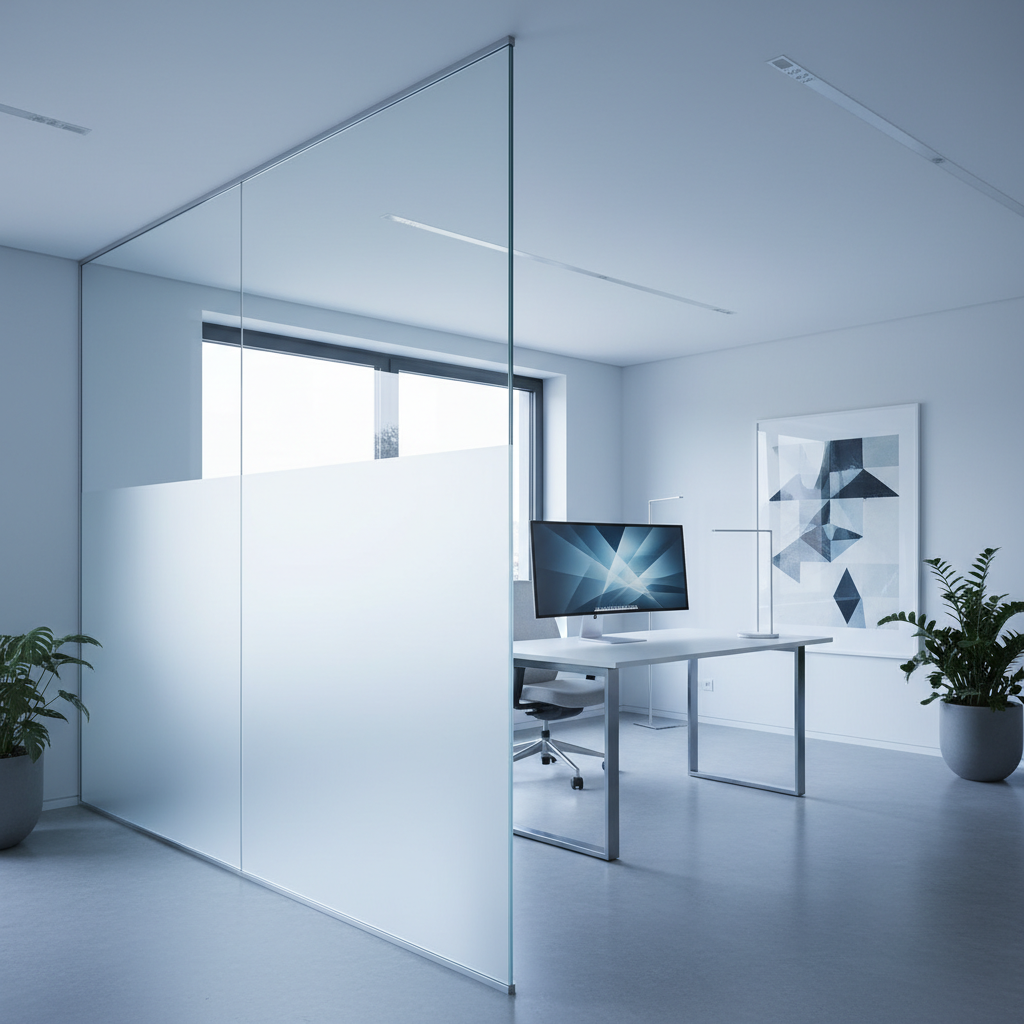
The short version: PDLC smart glass flips from transparent to frosted in under one second when you cut the power. A 48V AC transformer, a wall switch, and a licensed electrician's half-day visit are all the wiring a Toronto home office needs. Factory-laminated panels run $85-$150 per square foot; retrofit smart film on existing glass costs $30-$45.
The Home Office Privacy Problem Nobody Talks About
Toronto added roughly 400,000 permanent remote workers between 2020 and 2025. Many of them carved offices out of spare bedrooms, basement corners, and open-concept living spaces. And many of them discovered the same frustrating truth: drywall kills natural light, blinds look cheap, and frosted glass is permanent.
Smart glass fixes the root issue. You get a glass wall or partition that looks completely open when you want daylight and sightlines, then turns fully opaque with a single tap. No moving parts. No slats collecting dust. No compromise between privacy and light.
If you've been staring at a bland curtain during every Zoom call, this is the technology worth understanding before your next renovation.
How PDLC Smart Glass Actually Works
PDLC stands for Polymer Dispersed Liquid Crystal. The concept is simpler than it sounds.
A thin film containing microscopic liquid crystal droplets is sandwiched between two sheets of glass. When no electricity is flowing, those crystals point in random directions and scatter incoming light. The glass looks milky white—opaque enough that someone standing a foot away appears as a vague blur.
Apply an electrical current (typically 48 volts AC), and the crystals snap into alignment. Light passes straight through. The glass becomes transparent.
"It's privacy you can schedule around your meeting calendar—frosted at 9 AM, clear by lunch, frosted again for your 2 PM client call."
Switching takes less than one second in either direction. There's no gradual dimming or warming up. It's binary: clear or frosted.
One detail that surprises people: the glass is opaque in its default state, when power is off. That means if your power goes out during a snowstorm, your home office stays private. The electricity makes it transparent, not the other way around.
Smart Glass vs. Smart Film: Which One Do You Actually Need?
This is where most homeowners get confused, because installers use the terms loosely. They're two different products solving the same problem.
Factory-Laminated Smart Glass
The PDLC layer is sealed between two glass panes during manufacturing. You receive a finished panel ready to be glazed into a frame, just like any window or partition.
Best for: new builds, full renovations, or any project where you're already replacing glass. The laminated construction protects the PDLC film from moisture, scratches, and UV degradation. It's the more durable option by a wide margin.
Toronto cost range: $85-$150 per square foot, installed. Bulk orders over 100 square feet can bring the per-foot cost closer to $70-$100.
Retrofit Smart Film
A self-adhesive PDLC film applied directly to the interior surface of existing glass. Think of it as a high-tech window tint that happens to switch between clear and opaque.
Best for: homeowners who want switchable privacy without tearing out existing glass. Installation is faster and less disruptive—your installer applies the film, connects two wire leads, and hooks up a transformer. No glazing, no framing, no drywall patching.
Toronto cost range: $30-$45 per square foot, installed.
The tradeoff: because the film sits on the glass surface rather than inside it, it's more vulnerable to scratches and moisture. Lifespan is typically 8-12 years versus 20+ years for laminated panels. It also offers less thermal insulation than factory-laminated smart glass, which matters if your home office wall faces the exterior.
"Smart film is the renovation-friendly option. Smart glass is the build-it-right-the-first-time option. Both work. The right call depends on whether you're keeping your existing glass."
For most Toronto home office projects, the decision comes down to timing. If you're already doing a residential window replacement, laminated smart glass makes sense—you're swapping panels anyway. If your glass is fine and you just want to add switchable privacy, retrofit film saves thousands.
Wiring Requirements: What Your Electrician Needs to Know
This is the section that's hard to find honest information about online. Let's break down exactly what goes into the electrical side of a smart glass install.
The Transformer
Smart glass runs on low voltage—typically 48V AC. You can't plug it directly into a wall outlet. A step-down transformer converts your home's 120V supply to the 48V the panels need.
The transformer is roughly the size of a laptop power brick for a single panel. For multi-panel setups, you'll need a larger unit, usually mounted inside a closet, behind a cabinet, or in the mechanical room.
The Wire Run
Each smart glass panel has two wire leads—one red, one black—that connect to the transformer output. The wiring itself is low voltage, meaning:
- It doesn't need to run inside electrical conduit (though clean installations use it anyway)
- A glazier or glass installer can handle the panel-side connections
- The wire gauge is small enough to hide inside window frames, door jambs, or narrow channels routed into drywall
The critical rule: a licensed electrician must connect the transformer to your home's main electrical panel. In Ontario, that means someone with a valid ECRA/ESA licence. Low-voltage wiring on the glass side doesn't require an electrician, but the high-voltage feed to the transformer does.
The Switch
You have options:
- Wall switch: a simple dry-contact switch (no live phase) that sends a low-voltage signal to the controller. Safe to install near wet areas.
- Smart home integration: controllers from most manufacturers pair with Google Home, Apple HomeKit, Lutron, and Savant. You can add the glass to routines and automations.
- App control: dedicated smartphone apps let you toggle from anywhere—handy if you forgot to frost the glass before a meeting started.
- Timer/schedule: set the glass to frost automatically during working hours and go clear in the evening.
Typical Wiring Costs in Toronto
The electrical portion of a smart glass install is usually the cheapest part. Expect $300-$600 for an electrician's half-day visit to wire the transformer, install a switch, and verify code compliance. If you're running wire through finished walls with no existing pathway, add $200-$400 for fishing cables and patching.
"Budget the glass first, then the electrical. The wiring is a fraction of the panel cost—but skip the licensed electrician and your home insurance has something to say about it."
Safety Non-Negotiables
A few rules that apply to every smart glass installation in Ontario:
- Any metal framework near the wiring must be properly earthed
- Cable penetrations through metal frames require rubber grommets to prevent abrasion
- The transformer must be accessible for service—don't bury it behind permanent drywall
- All work must meet Ontario Electrical Safety Code and local building permit requirements
Where Smart Glass Makes Sense in a Toronto Home Office
Not every pane in your house needs to switch on demand. Here are the spots where smart glass delivers the most value per dollar:
Interior Partitions
The single most common residential application. A glass wall between your office and the living area stays open during family time and frosts for focused work or calls. This works especially well in condos and smaller homes where visual openness matters.
If you've explored soundproofing options for office partitions, smart glass is the visual privacy complement. Pair laminated smart glass with acoustic interlayers and you get both sound reduction and switchable opacity in one panel.
Street-Facing Windows
Ground-floor home offices in Toronto's older neighbourhoods—the Annex, Leslieville, Roncesvalles—often sit close to the sidewalk. Smart glass lets you enjoy the streetscape during the day and block prying eyes during evening work sessions without installing blinds that clash with original trim.
French Doors and Sidelights
Replacing solid panels in French doors with smart glass creates a dramatic effect: the doors look fully glazed most of the time, then frost completely when you need separation. Sidelights beside entry doors get the same treatment.
Bathroom-Adjacent Offices
For home offices that share a wall or door with a bathroom—common in converted master suites—smart glass provides a more elegant solution than permanent privacy film. The glass stays clear when the bathroom isn't in use, keeping the whole space brighter.
Integration with Smart Home Systems
Most Toronto homeowners running a home office already have some smart home infrastructure. Smart glass slots into that ecosystem cleanly.
Here's what integration typically looks like:
- Google Home / Alexa: "Hey Google, frost the office glass." Voice control is the killer feature for video calls—you don't have to stand up and walk to a switch.
- Apple HomeKit: add the glass to Scenes. Your "Focus Mode" scene dims the lights, silences notifications, and frosts the glass simultaneously.
- Lutron / Savant: for homes with whole-house automation, the glass controller ties into your existing lighting and shade system.
- Scheduling: set the glass to frost at 8:30 AM on weekdays and go clear at 5 PM. No daily interaction needed.
The controller that makes all this possible is a small box (roughly the size of a Wi-Fi router) mounted near the transformer. Most manufacturers include Wi-Fi and Bluetooth connectivity. If you're hardwiring into a Lutron system, your integrator handles the connection.
What a Realistic Project Timeline Looks Like
For a single home office partition in smart glass, here's the typical sequence:
- Consultation and measurement — 1 visit, 1-2 hours
- Glass fabrication — 3-6 weeks (panels are custom-cut and laminated to order)
- Electrical rough-in — 1 visit, half day (run transformer feed and low-voltage wire)
- Glass installation — 1 visit, half to full day
- Electrical finish — same day or next-day visit (connect transformer, test, certify)
Total elapsed time from order to working glass: roughly 4-8 weeks, with most of that being fabrication lead time.
Retrofit smart film is faster. Skip step 2 entirely, and steps 3-5 compress into a single day.
The Bottom Line for Toronto Homeowners
Smart glass is no longer a luxury-condo showpiece. Prices have dropped steadily, smart home integration is mature, and the wiring requirements are straightforward enough for any qualified electrician.
If you work from home and you're tired of choosing between natural light and visual privacy, switchable glass or film gives you both. The technology works. The installation is predictable. And the result is a home office that adapts to your day instead of the other way around.
Thinking about smart glass for your Toronto home office? Installix designs, supplies, and installs switchable privacy glass and smart film for residential projects across the GTA. We handle the glass, the framing, and the electrical coordination—so you get one point of contact from measurement through final switch test. Start with a free consultation.