Glass Railings: Spigots vs. Base Shoe vs. Standoffs

Too Long; Didn't Read
Spigots grip individual points for a floating, airy look. Base shoes run a continuous channel along the bottom for maximum rigidity. Standoffs bolt through the glass face for an industrial edge. Each system meets Ontario Building Code — the right pick depends on your sightlines, budget, and whether the install is indoor, outdoor, residential, or commercial.
Answer first: Spigots clamp the glass at discrete floor-mounted points for maximum airiness. Base shoe channels cradle the entire bottom edge for rock-solid rigidity. Standoffs bolt through the glass face for a bold, industrial statement. All three meet Ontario Building Code — the "best" one depends on your sightlines, substrate, budget, and whether you are indoors or out.
Why Toronto homeowners are obsessing over glass railing systems
Walk through any new condo lobby on King West or step onto a freshly rebuilt Leslieville deck and you will notice the same trend: wooden spindles and wrought-iron pickets are gone, replaced by clear glass that makes a space feel twice its size. Glass railing systems have moved from luxury penthouse territory into mainstream Toronto renovation budgets — and for good reason. They let in light, protect sightlines, and handle our freeze-thaw winters better than most people expect.
But here is the part that trips up nearly every homeowner and contractor I talk to: the glass itself is only half the decision. The mounting hardware — spigots, base shoes, or standoffs — determines how your railing looks, how it performs under load, how much it costs, and how painful the install will be. Pick the wrong system for your application and you end up with a beautiful panel of glass that rattles in the wind, drains your budget, or fails inspection.
This guide breaks down all three systems head-to-head so you can walk into your next consultation knowing exactly what to ask for.
The quick visual breakdown
Think of it this way:
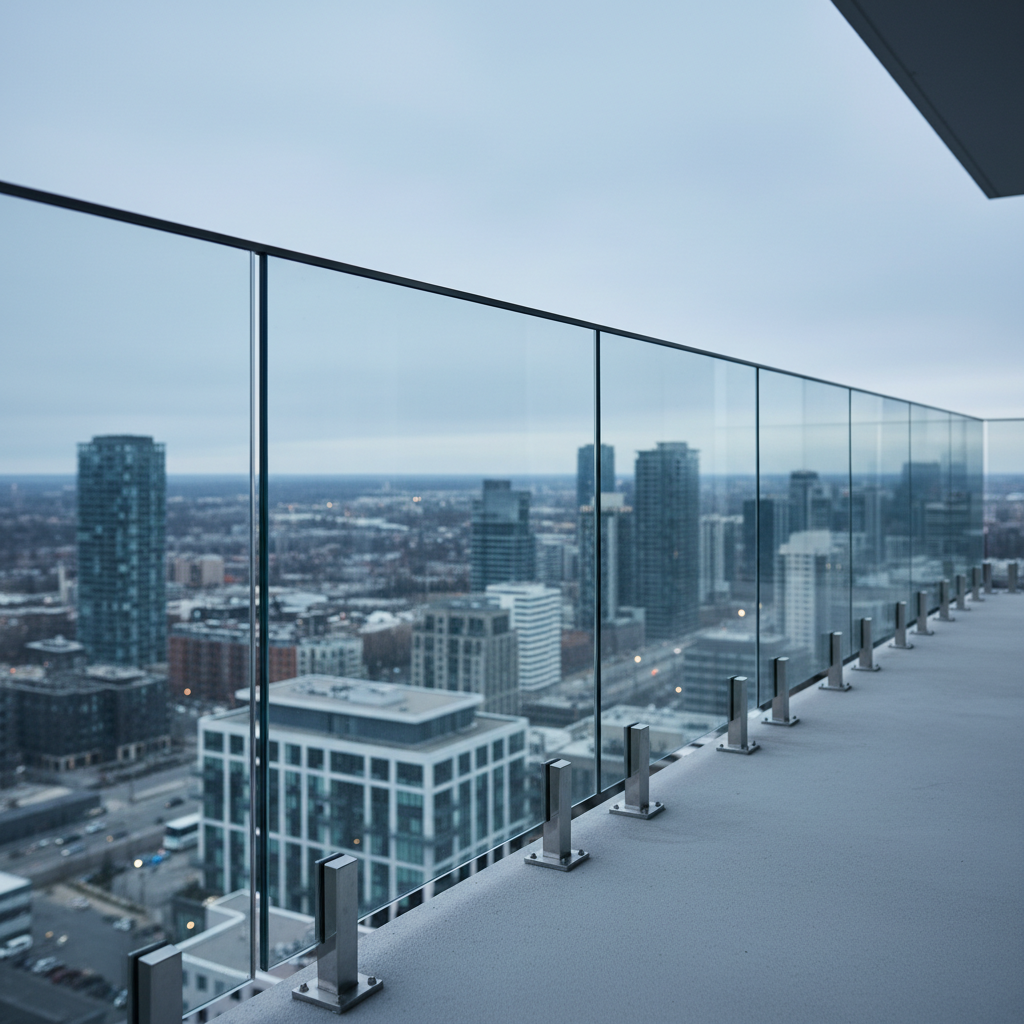
- Spigots — small metal clamps or "mini-posts" that grab the glass at its bottom edge, two or three per panel. The glass appears to float above the floor.
- Base shoe (U-channel) — a continuous aluminum channel bolted to the deck or floor. The glass sits inside the channel and is wedged tight. Nothing visible below the glass except a slim metal strip.
- Standoffs — cylindrical metal bolts that pass through drilled holes in the glass face and anchor into the wall or post behind. The glass "hovers" away from the structure.
Each approach affects aesthetics, structural behaviour, code compliance, cost, and maintenance differently. Let us get into the details.
Spigots: the floating, airy look
How they work
A spigot is essentially a stainless-steel clamp — sometimes called a "glass talon" — that mounts to the floor, fascia board, or concrete slab. The glass panel drops between the jaws of each spigot, and a set screw or compression gasket locks it in place. Most panels require two to three spigots depending on width.
Where spigots shine
Unobstructed views. Because the hardware footprint is tiny, spigots deliver the closest thing to invisible mounting you can get at a moderate price point. If you have got a Muskoka cottage with a lake panorama or a Cabbagetown rooftop deck overlooking the skyline, spigots let the scenery do the talking.
Outdoor durability. Marine-grade 316 stainless steel spigots handle Toronto's salt-spray winters and humid summers without pitting. No painting, no staining, no annual refinishing — a far cry from the cedar spindle railings they replace.
Retrofit friendliness. Because each spigot is an independent anchor point, you can mount them to wood framing, concrete, steel beams, or composite decking with the right fastener kit. That flexibility is gold during renovations where the substrate is never perfectly consistent.
Quotable nugget: "Spigots are the earbuds of glass railing hardware — tiny, almost invisible, but doing all the heavy lifting."
Where spigots fall short
Point loading. The glass is supported at just two or three discrete spots along its bottom edge. That concentrates stress, which means the glass needs to be thick enough and tempered (or laminated) enough to handle the cantilever. For panels taller than 42 inches, engineers sometimes require heavier hardware or closer spigot spacing, and the cost advantage starts to erode.
Alignment sensitivity. Each spigot must be level with its neighbours to within a couple of millimetres. On a slightly wavy deck or an older concrete balcony with settling, achieving that precision can add labour hours — and frustration.
Limited wind-load forgiveness. In exposed, high-rise applications above the tenth floor, individual spigots can transmit more vibration to the glass than a continuous channel would. Not a dealbreaker, but something your structural engineer will want to model.
Typical cost (Toronto, 2026)
Expect roughly $200–$280 per linear foot installed for a frameless spigot system with 12 mm tempered glass and stainless hardware. Laminated panels or tinted glass push that toward $300+.
Base shoe (U-channel): the solid, seamless option
How it works
A base shoe is an extruded aluminum channel — picture a squared-off "U" — that gets anchored to your floor, deck surface, or the face of a concrete slab. The glass panel slides down into the channel, and rubber or PVC setting blocks wedge it plumb. Some systems use a structural silicone or grout pour to lock the panel permanently; others rely on mechanical wedges so the glass can be removed later for maintenance.
Where base shoes shine
Continuous support. The channel cradles the entire bottom edge of every panel. That distributed load path is why base shoes are the go-to for commercial lobbies, public stairwells, and any application where code authorities want to see maximum rigidity. If you have ever walked past the glass guards in a new Toronto PATH tunnel and noticed zero wobble, you were probably looking at a base shoe install.
Tolerance for uneven substrates. A continuous channel can be shimmed and adjusted along its full length far more easily than a dozen individual spigot points. For older Toronto homes where the deck joists have settled or the concrete balcony has a slight crown, base shoes save serious headache.
Sleek aesthetic on straight runs. On a long, uninterrupted balcony — think a 30-foot condo terrace — the base shoe virtually disappears, leaving nothing but a thin metal line at floor level. The visual is clean, architectural, and timeless.
Quotable nugget: "Base shoes are the foundation walls of glass railing systems — you never really notice them, but they are doing all the structural work underneath."
Where base shoes fall short
Drainage and debris. That channel is basically a gutter. Leaves, dirt, and standing water collect inside it, and if the weep holes get plugged, freeze-thaw cycles can crack the setting blocks or stress the glass edges. In Toronto, where October dumps leaves and January dumps snow, a clogged base shoe is a maintenance headache you need to plan for.
Curved or angled runs. Standard aluminum channels come in straight lengths. If your deck has a curve or your staircase changes angle every few treads, each transition requires a custom-cut section and a splice joint. That drives up fabrication time and cost compared to spigots, which can follow any geometry one clamp at a time.
Slightly higher profile. The channel adds roughly 50–75 mm of visible metal at the base. On an interior staircase where you want maximum glass-to-floor transparency, that strip can feel heavier than a pair of slim spigots.
Typical cost (Toronto, 2026)
A frameless base shoe system with 12 mm tempered or laminated glass generally runs $150–$250 per linear foot installed in the GTA. The channel hardware itself is relatively inexpensive; most of the cost is in the glass and labour. Longer straight runs push the per-foot number down, while short, segmented runs with lots of corners push it up.
Standoffs: the bold, industrial statement
How they work
Standoffs are cylindrical metal mounts — usually stainless steel or brushed nickel — that bolt through pre-drilled holes in the glass panel and anchor into a wall, post, or structural member behind it. Rubber bushings isolate the glass from the metal to prevent cracking. The glass "floats" an inch or two off the mounting surface, creating a shadow gap that gives the system its signature industrial look.
Where standoffs shine
Architectural drama. Standoffs make a deliberate visual statement. The exposed hardware becomes a design element — rows of polished steel circles dotting the glass like rivets on an aircraft fuselage. In converted-loft spaces in Liberty Village or warehouse-style offices in the Junction, that industrial DNA fits perfectly.
Wall-mount versatility. Unlike spigots and base shoes, which mount to horizontal surfaces, standoffs anchor to vertical surfaces — walls, columns, steel beams. That makes them ideal for interior partitions, mezzanine guards, and staircase-side panels where there is no floor edge to clamp to.
Panel replacement. If a panel cracks (it happens, even with tempered glass), standoff systems often allow single-panel swap-outs without disturbing the rest of the run. Unbolt four standoffs, slide the panel out, slide the new one in.
Quotable nugget: "Standoffs do not try to hide — they turn every bolt into a design detail. Think of them as the exposed-brick of glass railing hardware."
Where standoffs fall short
Drilling cost. Every standoff requires a precision-bored hole in the glass — typically 22 mm diameter — with polished edges to prevent stress fractures. That drilling has to happen at the glass fabrication shop before tempering, which means zero field adjustments. Measure wrong and you are ordering a new panel. That precision drives the per-panel cost higher than spigot or base shoe glass.
Load limitations on thin glass. Because the bolt passes through the glass, the panel is the structural link between the mounting surface and the load. Thinner glass (10 mm or under) may not satisfy engineering calcs for guard-height standoff applications. Most standoff railings spec 12 mm tempered laminated minimum, and some high-traffic commercial specs call for 15 mm.
Not ideal for floor-mounted guards. Standoffs are designed to push the glass away from a vertical surface. Using them on a horizontal floor mount is technically possible but awkward — you end up with protruding bolts underfoot, which creates a trip hazard and a cleaning nightmare. For deck or balcony guards, spigots or base shoes are almost always the smarter call.
Typical cost (Toronto, 2026)
Budget approximately $250–$350+ per linear foot installed. The premium comes from the precision-drilled glass panels and the higher piece count of hardware per linear foot. Brushed or polished finishes on the standoffs add another 10–15% versus satin stainless.
Side-by-side comparison table
| Factor | Spigots | Base Shoe | Standoffs |
|---|---|---|---|
| Look | Airy, floating | Seamless, architectural | Industrial, bold |
| Support type | Point (2–3 per panel) | Continuous channel | Point (4+ per panel) |
| Best substrate | Floor, fascia, slab | Floor, slab | Wall, column, post |
| Curved runs | Easy (individual clamps) | Difficult (custom cuts) | Moderate (drill layout) |
| Uneven surfaces | Challenging | Forgiving | Moderate |
| Glass prep | Standard cut + temper | Standard cut + temper | Precision-drilled holes |
| Cost (GTA, 2026) | $200–$280 /LF | $150–$250 /LF | $250–$350+ /LF |
| Best for | Decks, rooftops, views | Lobbies, balconies, straight runs | Lofts, mezzanines, partitions |
Ontario Building Code: what all three systems must satisfy
Regardless of which mounting hardware you choose, your glass railing in Toronto needs to tick the same OBC boxes:
- Guard height. Minimum 36 inches (914 mm) for single-family residential. Minimum 42 inches (1,067 mm) for commercial, multi-unit residential, and any guard more than 600 mm above grade.
- Glass type. Tempered safety glass at minimum. Laminated tempered glass is required where a walkway exists below the guard — which covers most balcony and mezzanine situations. The glass must meet CAN/CGSB 12.1-2017 certification.
- Thickness. 12 mm minimum for most frameless applications. Outdoor railings require at least 8 mm, but in practice no reputable Toronto installer specs anything under 10 mm for a guard-height application.
- Top rail or handrail. If you are using single-panel glass balusters (common with standoffs), code requires an attached top rail supported by at least three balusters — unless the glass is laminated and tested to remain a barrier after impact.
- Load resistance. All guards must resist a 1.5 kN concentrated load and a 0.75 kN/m distributed load applied at the top. Your installer should have engineering calcs or a tested assembly letter for whichever system they propose.
None of these rules favour one mounting type over another. Spigots, base shoes, and standoffs all have tested assemblies that pass OBC — the difference is in the engineering details and the hardware spec sheet, not the code itself.
Tempered vs. laminated glass: a quick detour
This question comes up in every railing consultation, so let us clear it up.
Tempered glass is heat-treated to be roughly four times stronger than standard annealed glass. When it breaks, it shatters into small, relatively harmless pebbles. Great for safety, terrible for keeping a barrier intact after failure.
Laminated glass sandwiches an interlayer (usually PVB or SGP) between two sheets of glass. If one layer cracks, the interlayer holds everything together — the panel stays in the frame, the barrier function is maintained, and nobody walks through a gap four stories above the sidewalk.
For guard-height railings above a walkway, Ontario code effectively mandates laminated construction. You can use tempered laminated (the best of both worlds) or heat-strengthened laminated. Tempered-only panels are reserved for situations where no occupied space exists below — think a ground-floor pool fence or a partition wall.
If you are curious about how glass thickness affects safety in wet-area applications, our breakdown on custom shower glass thickness in Oakville bathroom renovations covers the topic in detail.
How to choose: a decision flowchart in plain English
Start with the substrate.
- Mounting to a floor, deck, or slab? Spigots or base shoe.
- Mounting to a wall, column, or post? Standoffs.
Next, consider the run geometry.
- Long, straight runs? Base shoe will look the cleanest and cost the least.
- Curved, angled, or segmented runs? Spigots adapt one clamp at a time.
- Interior partition or mezzanine edge? Standoffs give you the shadow-gap drama.
Then, factor in your aesthetic.
- Want the glass to "float" with almost no visible hardware? Spigots.
- Want a sleek, unbroken base line? Base shoe.
- Want the hardware to be the design feature? Standoffs.
Finally, check the budget.
- Tightest budget on a straight run? Base shoe.
- Mid-range with maximum view? Spigots.
- Willing to pay for architectural impact? Standoffs.
Installation realities Toronto contractors deal with
A few things I have seen come up repeatedly on job sites across the GTA that rarely make it into the glossy product brochures:
Condo board approvals. If you are replacing a balcony guard in a Toronto condo, the corporation almost certainly has an approved hardware spec. Some buildings mandate base shoe only (for uniformity); others allow spigots but not standoffs. Check the declaration and the engineering reserve study before you fall in love with a system.
Winter installs. Structural silicone — used in many base shoe systems — does not cure well below 5°C. If your project timeline lands in January, mechanical-wedge base shoes or spigot systems are more forgiving. Standoffs are hardware-only, so temperature is irrelevant to the mount itself — but handling large glass panels on a windy February balcony is its own kind of adventure.
Waterproofing coordination. On a deck or balcony, the base shoe channel penetrates the waterproofing membrane. Your installer and your waterproofing contractor need to be on the same page, or you will be chasing leaks into the unit below within two years. Spigots have smaller penetrations but still need proper flashing.
Maintenance by system type
Spigots: Inspect set screws and compression gaskets annually. Salt and calcium buildup around the base is common in Toronto — a quick wipe with white vinegar handles it. Budget five minutes per spigot, twice a year.
Base shoes: Clear weep holes before every winter. Pull out leaves and grit from the channel in autumn. If the system uses structural silicone, inspect the sealant bead every three to five years for UV degradation and re-apply as needed.
Standoffs: Check bushing condition annually — the rubber isolators can dry out and crack after seven to ten years, especially on south-facing exterior installs. Replacement bushings are cheap; the labour to remove and reinstall the glass is not. Keep a spare set on hand.
For all three systems, clean the glass itself with a mild dish-soap solution or a 50/50 water-vinegar mix. Avoid abrasive pads. If you are maintaining a large commercial installation, a professional glass cleaning once or twice a year keeps things looking sharp — and it is a fraction of the cost of repainting a metal railing system.
If your project involves broader window or glass work alongside the railing, our residential window replacement and commercial glass repair teams handle both under one scope, which simplifies scheduling and keeps the trades coordinated.
Real project scenarios in the GTA
Riverdale Victorian deck — Homeowner wanted max backyard views. Spigots with 12 mm tempered laminated glass and a slim top rail. The hardware stayed visually quiet; the top rail satisfied OBC's three-baluster support rule.
King West condo lobby — 80 linear feet of dated guards to replace along a main staircase. Base shoe was the clear winner: long straight runs, concrete substrate, uniform low-profile look the condo board demanded.
Junction loft mezzanine — Former factory converted to a live-work studio. Standoffs in brushed stainless, 15 mm tempered laminated glass, no top rail (laminated panels qualified for the single-baluster exception). The exposed bolts echoed the building's industrial steel beams.
Wrapping it up
There is no universal "best" glass railing system. There is only the best system for your specific slab, sightline, budget, and building code scenario. Spigots give you air. Base shoes give you solidity. Standoffs give you industrial character. All three keep you code-compliant in Ontario when specced and installed correctly.
The mounting hardware is the decision that lives with you for 20+ years, so it is worth getting right the first time. Measure twice, consult your engineer once, and do not let anyone talk you into a system just because it is cheaper or trendier — let the application dictate the hardware.
We help homeowners and contractors choose the right mounting system, spec the correct glass, and handle the full install — from engineering calcs to final inspection. Reach out for a free consultation or call us at (647) 600-4842.